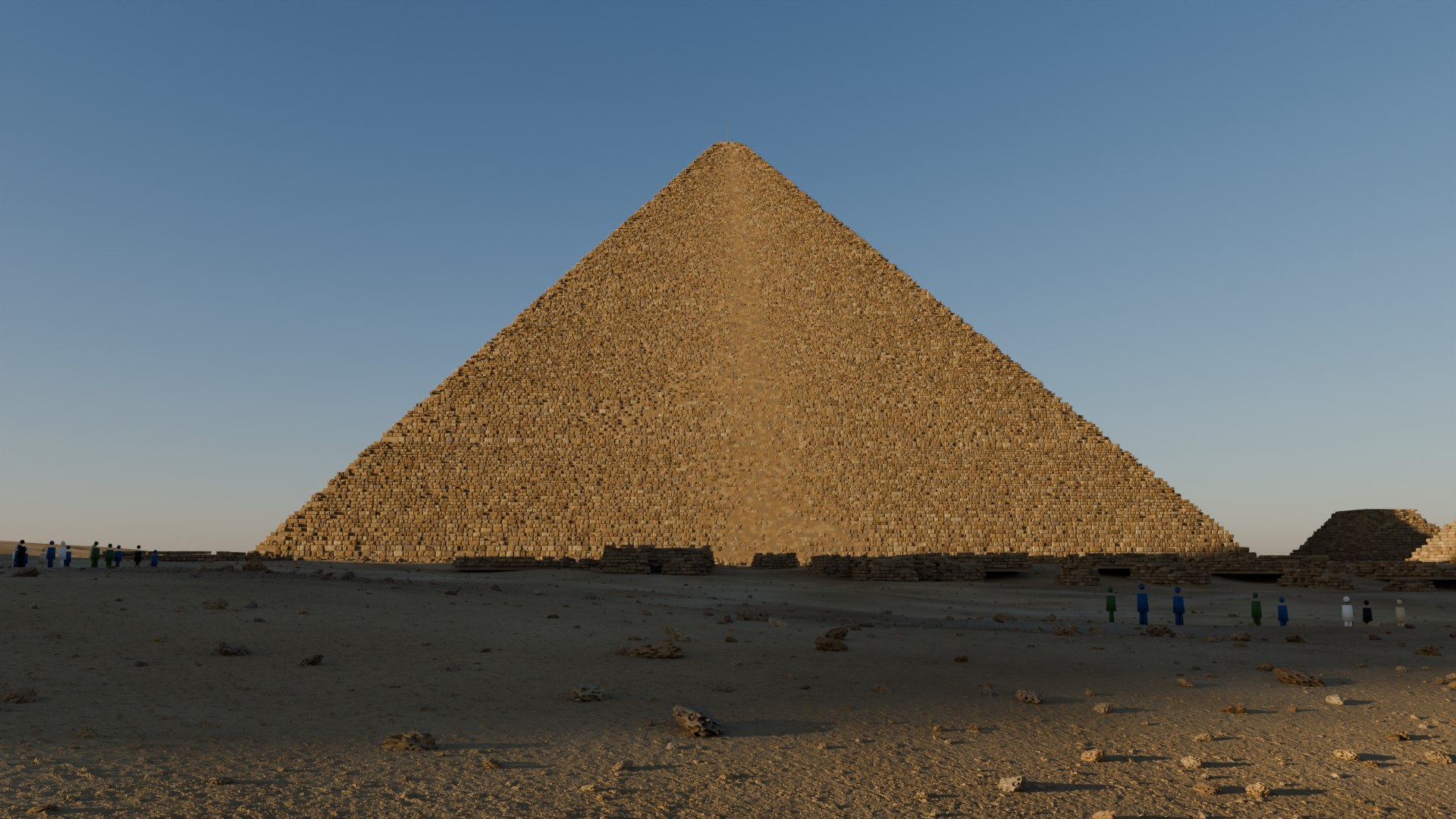
Path traced in Blender Cycles from the project's own data: Petrie's and Cole's base dimensions, Goyon's 201 measured course heights for Khufu, the Copernicus GLO-30 terrain, OpenStreetMap footprints, Google Open Buildings for the modern city. The individual blocks, the erosion and the rubble are a reconstruction at block scale. The temples, causeways, harbour, Wall of the Crow and the Sphinx's five forms stand on their surveyed footprints, with their look choices named in the code; the vegetation is a look choice throughout. The interiors are Petrie's survey. The stars are the project's sky engine, precessed to each night's epoch.
Seked · 24 September 2026
Keep going. The fidelity is there.
You asked whether this could ever look the way you want. It can. What held it back was not effort and not the data. It was where the detail lived and what was drawing it. The first station of the walkthrough was built in an afternoon from numbers the project already had, laid block by block, and lit by a path tracer instead of a game renderer.
Since the first station
The same evening, the walkthrough grew into this:
- The guided tour. The case for an older Giza, in ten stops: the Sphinx's rain weathering, the valley temple's megaliths, the lion and Leo, the sun in the horizon sign, Orion's belt on the ground with its stars drawn over the night sky, the shafts, the chamber under the rock, the Earth-scale numbers, and the Younger Dryas. Each stop moves the view and runs the eras, with the project's own figures beside the argument.
- Five eras on one timeline. The First Time, c. 10,500 BCE, drawn as the lost-civilisation claim describes it at its strongest: an unknown people's work, the pyramids pristine under a polish no Old Kingdom mason matched, electrum at their tips, the lion Sphinx facing its constellation, and a humid, forested green Sahara under towering cloud. The long rains, c. 7000 BCE, also a claim: the same stone streaked by millennia of rain, the lion weathered as Schoch reads the Sphinx's ditch. Khufu's Giza, c. 2560 BCE, which the claim reads as the Egyptians' restoration of what they inherited and the mainstream as their building of it: an ivory casing that shows its age, with gold and electrum caps, enclosure walls, dressed mastabas, the roofed causeway, the red granite temples, the harbour with its quay and boats, and the Wall of the Crow. The plateau of c. 1800, the Sphinx buried to its chest. And today.
- Seventeen stations. Among them a papyrus raft on the harbour, the court of Khufu's mortuary temple, the Eastern Cemetery, Menkaure with his granite casing and three queens, a close view of the Sphinx's face in each of its forms, the main street of the builders' town, the granite hall of Khafre's valley temple, and four inside the Great Pyramid: the Grand Gallery, the King's Chamber with the coffer where Petrie found it, the Queen's Chamber with its corbelled niche, and the unfinished subterranean chamber cut into the bedrock, all from his interior survey.
- People. Men on the quay and priests in the temple court as built, and visitors today: figures generated for the project and labelled as look choices, not portraits of anyone.
- The Sphinx in its ditch. The elevation model under the scene averages its 30 m cells, and averaged the quarry round the Sphinx almost flat, so the statue seemed to sit on open ground. The rock round the ditch now stands at the height the model gives 35 m out, beyond the averaging: walls of 11 to 13 m behind the rump, lower along the causeway, a look choice and labelled as one. The caps of the as-built pyramids are beaten gold and electrum, hammered so they catch the sun instead of mirroring the sky.
- Khafre's granite hall. Inside the valley temple, as built and as it stands today: the T-shaped hall of red granite with its sixteen pillars, its size from Petrie's plan and text of 1883 and its place in the temple from Hölscher's of 1912, which agree to a centimetre. It is lit as it was, by the glow its wall slits let down from the roof and the daylight at the end of the passage east, on an alabaster floor. Twenty-three seated Khafres stand along the walls where Hölscher found the statues' sockets: one museum scan, labelled a stand-in, drawn for all of them. Today the roof is gone and the sun comes in, and six of the beams are missing, as Petrie found them.
- Orion over Giza. The night of 10,450 BCE, the date the claim gives. The project's own sky engine precesses every star to that epoch, and Orion's belt barely clears the horizon between Khufu and Khafre. The as-built night is 2450 BCE, with the belt high in the south.
- The builders' town. South of the Wall of the Crow as built: blocks of galleries, the walled granaries and the houses of the town the crews lived in, an impression after the layout AERA has published from its excavations, with a station in its main street.
- Films. On the Films page: the rollback from today to the First Time, the Sphinx's sequence from the lion of the First Time to the statue of today, a flight in to Menkaure as built, a low pass over the First Time's flood to the Anubis Sphinx, a lamplit climb up the Grand Gallery, and the night sky rolling back twelve and a half thousand years.
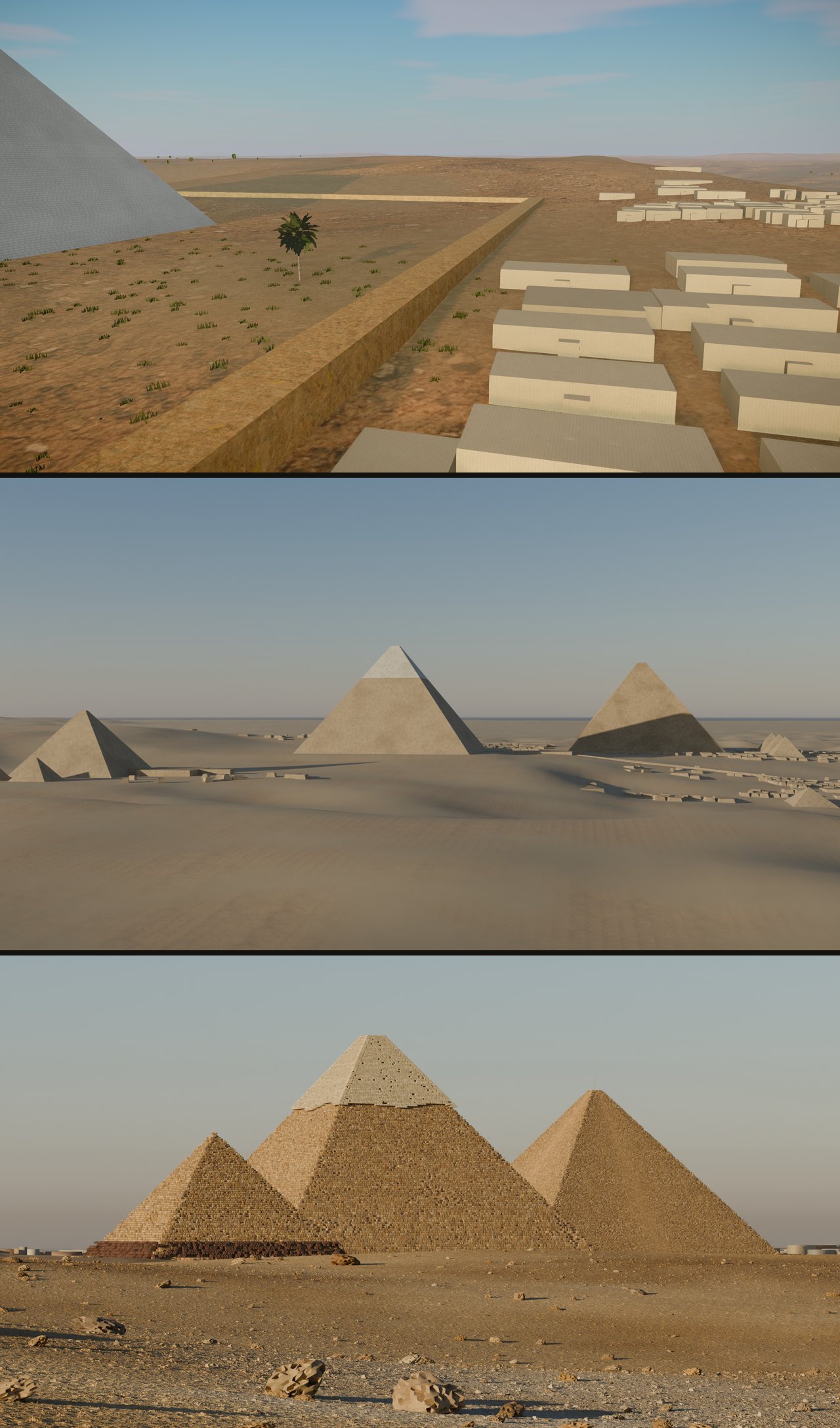
Then and now, from the same spot
Drag across each frame. The present day is laid from blocks: Khufu's 201 courses, Khafre's surviving cap with its ragged lower edge, Menkaure's band of red granite casing. The as-built plateau is dressed casing, satin rather than mirror, sharp at every arris. Both come from the same model, switched at render time.
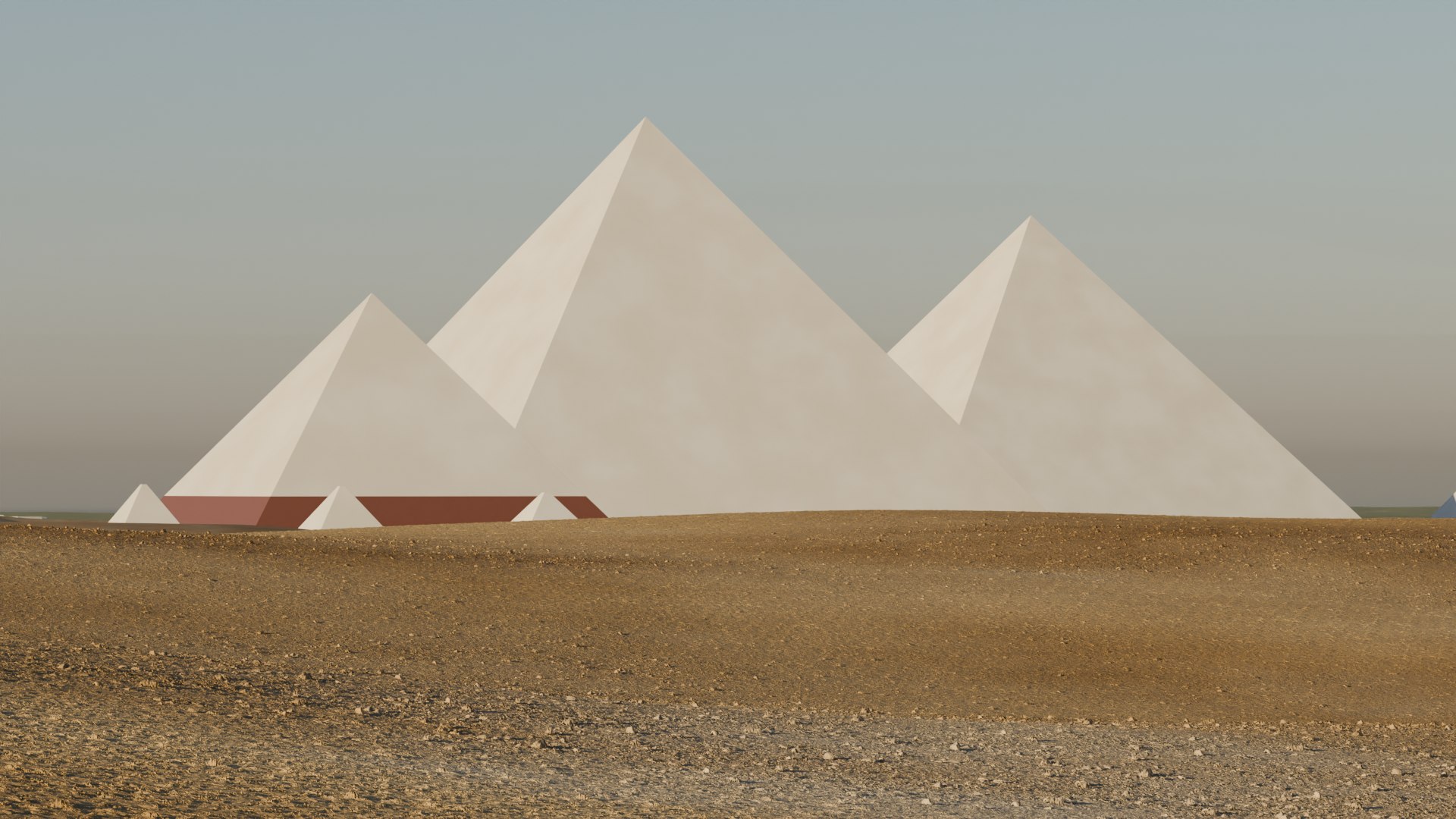
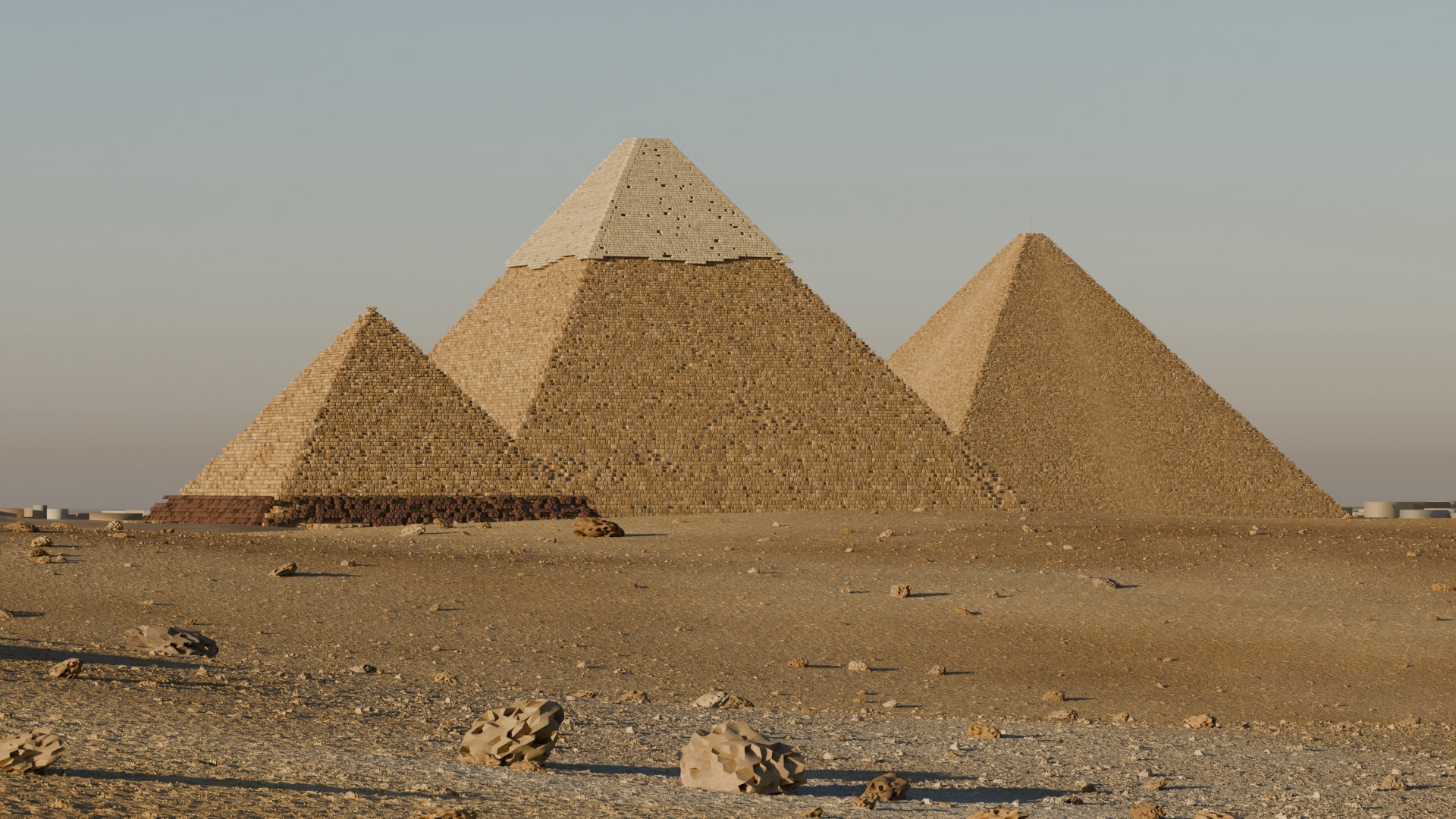 Todayc. 2560 BCE
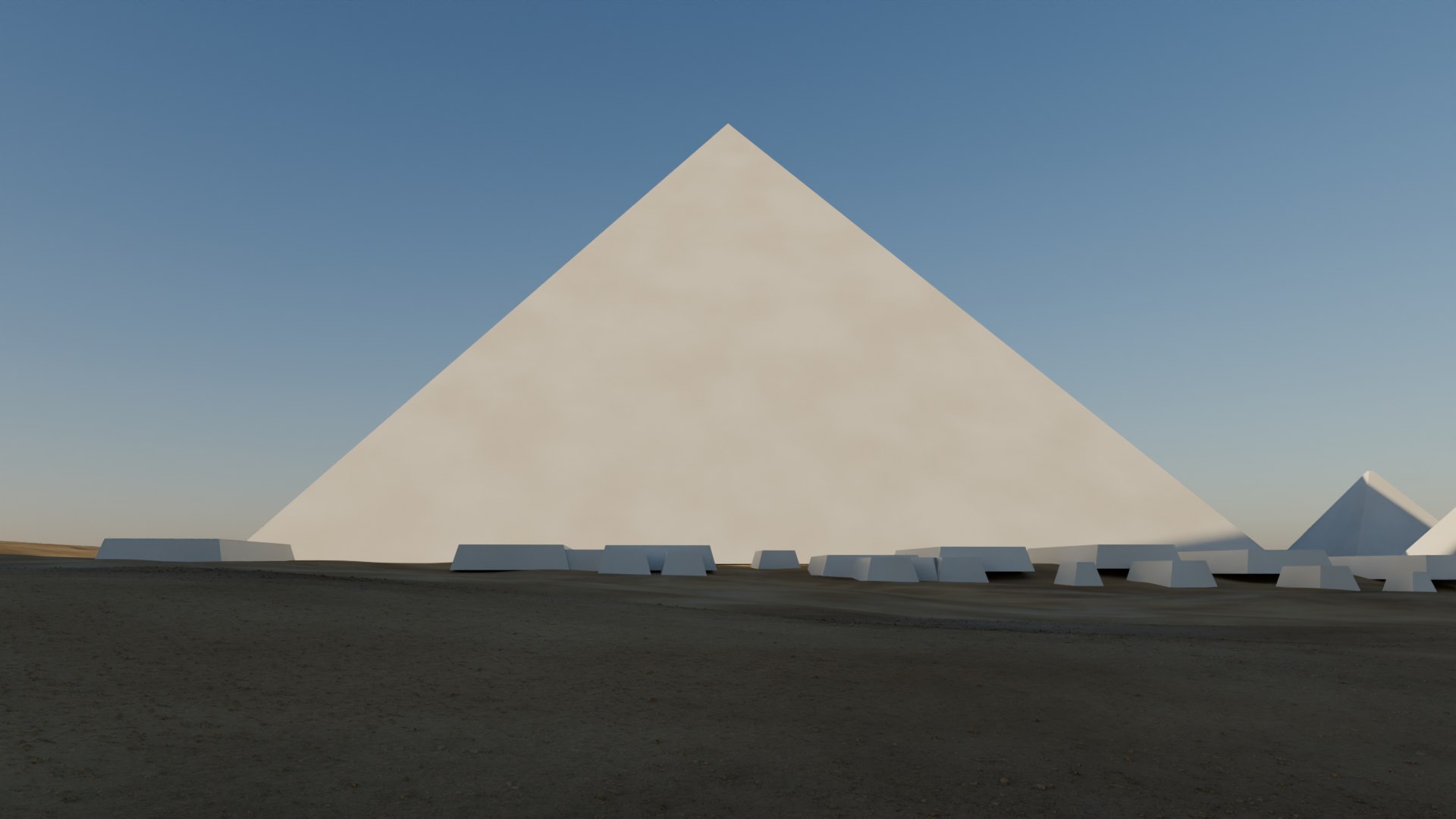
 Todayc. 2560 BCE
What was holding it back
Detail at the survey's scale, none at the eye's
The old scene modelled a pyramid as five faces and a temple as its footprint pushed up into a box. The eye reads Giza at the scale of blocks: 201 courses on Khufu, a ragged skyline where the corners were robbed, rubble at every foot, sand in every step. None of that existed, so no amount of lighting could make it look real.
A game renderer
The web viewer drew everything in real time, which means no true bounce light. At Giza the bright sand lights the pyramids from below, and without it every face reads flat. Much of the last week went into frame rates rather than into the stone.
Proof paperwork on every stone
Every visual element had to be a sourced record, a TypeScript builder, a Python mirror and a test that the two agree. That is right for a claim and far too heavy for a pebble.
What changes
Blender's path tracer draws it
Light is computed, not approximated: bounce light off the sand, the soft shadow of the whole sky, the sun reddened by the air it crosses.
Everything at the scale you see it
Pyramids course by course from measured course heights where they exist. Blocks sized, weathered and missing by rule, and labelled as reconstruction.
A walkthrough of stations
Each station is a 360° path-traced panorama like the ones in the walkthrough, in each era, with the slider between them. Flights between stations are pre-rendered film.
The claims draw on top
Every station's camera is known exactly, so the claims engine and the star calculations can draw their lines and stars over the panorama live, registered to the pixel.
What stays: the measurement database and its sources, the sky engine with its precession and star catalogue, the claims engine and the Claude claims runner, the rule that a reconstruction is always labelled, and the current web viewer, kept as the survey tool rather than the showcase.
The plan
The generator (done)
Today's spike became the project's pipeline: terrain, pyramids, mastabas, rubble, city, sky, and stations described as data. The render queue runs as detached jobs so no session is woken by a finished frame.
The rest of the plateau (done, but for the Mena House)
Khafre's valley and mortuary temples in red granite, the causeways, the Sphinx in its enclosure, the enclosure walls, today's roads, the green valley and the harbour for the as-built plateau.
Twelve to twenty stations (seventeen so far)
Each rendered in every era it exists in, starting at golden hour.
Inside Khufu (the Grand Gallery, the King's and Queen's Chambers, the subterranean chamber)
Next: the descending passage and the relieving chambers, from the interior survey already in the database.
Night stations (Orion over Giza, and the sky rolled back in a film)
Next: the shafts and their stars, with the live star overlay drawn on the night panorama.
Films (six so far)
Flights between stations, the rollback from today to the First Time, the Sphinx's sequence, the Grand Gallery by lamplight and the precessing sky.
Costs and limits
| Render, on your RTX 5070 Ti laptop | Time |
|---|---|
| Full-HD hero frame, 128 samples | about 1 min |
| 4K station panorama, 48 samples | about 40 s |
| The whole walkthrough, 38 panoramas in five eras | about 40 min |
| 8K station panorama, 64 samples (estimate) | about 5 min |
| Twenty stations in three eras at 8K | one night |
Rendering is not the constraint I feared. A whole walkthrough renders overnight on your laptop, as detached jobs that wake no session when they finish. The two 4K panoramas in the walkthrough are just over a megabyte each, so hosting is no concern either. The trade, plainly: this is not free roaming in real time. You said locked scenes were fine, and locked scenes are exactly what buys this look.
From you
Nothing is blocking. I am carrying on with the generator. If you want any of this held back or pointed elsewhere, say so and I will change course.
Housekeeping: the project now lives in C:\Users\stewa\ClaudeProjects\seked, off OneDrive, and every commit is pushed to GitHub, including twelve from last week that were only on your disk. The old OneDrive copy is marked stale and can be deleted when you like.